The stories history leaves behind
Nobel laureate Svetlana Alexievich in her novel 'Last Witnesses' gives voice to those who experienced the Second World War as children
I remember everything. I remember how the adults said: ‘He is little. He doesn’t understand.’ And I was astonished: ‘How strange these adults are, why have they concluded that I understand nothing? I understand everything.’ It even seemed to me that I understood more than the adults, which is why I do not cry, while they cry. War: that is my history textbook. My solitude… I missed the time of childhood, it fell out of my life. I am a person without a childhood; instead of childhood I have – war.
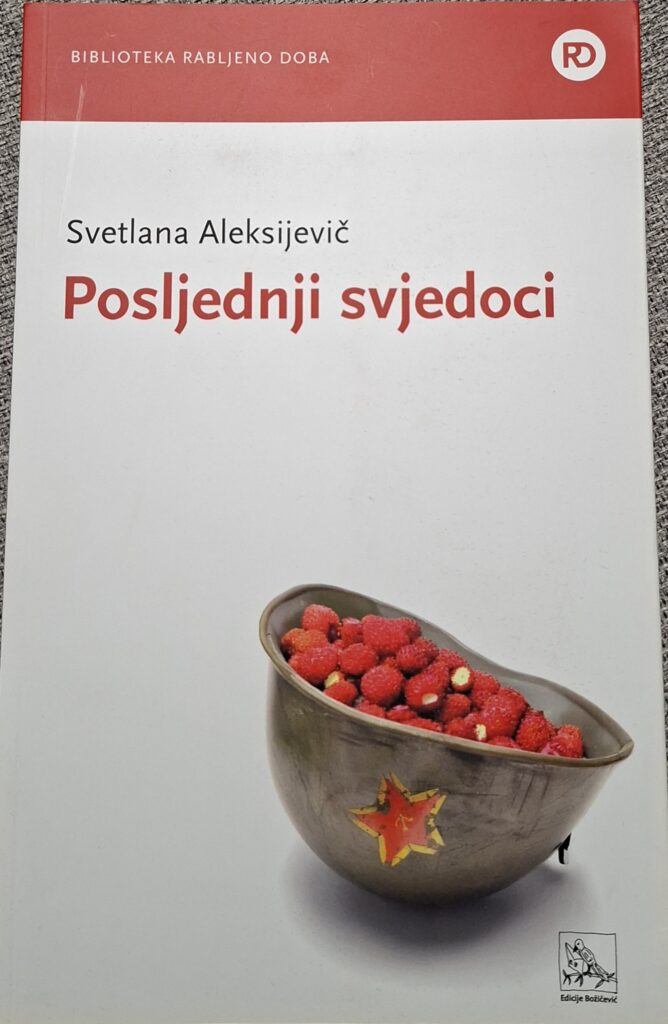
Last Witnesses, Svetlana Alexievich, Edicije Božičević
Svetlana Alexievich, as in all her previous books, fills in the gaps that great history – and that is mostly the history of wars and catastrophes – has left behind. Catching the last witnesses, moments of sincerity, searching for truths more important than those recorded by historians. Truths often never before spoken aloud. It might be more accurate to say that her books (novel is here a very arbitrary term, simply because a great many things can fit beneath its broad umbrella) are perfect journalism transformed into literature. Although even such a definition would be insufficient and too narrow.
But the method Svetlana Alexievich uses so perfectly – I would dare say the method she invented – at the same time turns each of her stories, each of her testimonies, into a perfect document and chronicle of some past time, a short story that is part of a great novel, a fairy tale or legend, and a perfect reportage. It is almost impossible to combine all those elements and still not once stray from the main road. From the main line of narration. And Svetlana Alexievich succeeds at that every time: the current of her story spills into hundreds of little tributaries, yet it constantly flows toward the same goal.
“Last Witnesses: One Hundred Unchildlike Stories” (as the direct translation of the title would be) tells the stories of children – then children, now grown people who are slowly disappearing forever – about the Second World War, about the attack on the Soviet Union. But these are also stories, untold stories, about all wars. Svetlana Alexievich reduces her narrators solely to their story seen through children’s eyes, seen through the eyes they had when they were children, now that they are old people making their way through the veils and mists of time. That procedure at once gives each confession, each view of that great war, uncensored authenticity, but also the flavor of some cruel fairy tale. Stripped of all excess, of all additional meanings, of all markers of time and place, of all characterization of the narrator, each of those stories tries – and succeeds – to bear witness to the very core of something inconceivable: war. Although those books are completely different, both in the manner of narration and in their narrators, Miljenko Jergović’s novel (or collection of stories, though I prefer to call it a novel) “War”, one of the most important books written in our language, and Svetlana Alexievich’s “Last Witnesses” at moments resemble one another. Better still, they speak to one another in the way great books communicate among themselves.
The search for a chronicle, for a story, for a history that has not been poured into documents and that has been worn down by years which have erased traces, blurred memories, and given them entirely new meanings, is in fact an extremely difficult task. In trying to recover certain family stories from the distant past, stories I heard as a child and am now attempting to hear again from direct witnesses, but also from those who were only listeners to the telling, it is almost impossible to establish the exact sequence of events, the precise dates, even the names. But what is beyond dispute, what lies behind all those distorted – and in fact unimportant – facts, is that all those stories, however distorted they may be, at their core contain one and the same truth, the same narrative, the same feeling and the same meanings those stories held for the people who lived them and for those who experienced them by listening. And surely all those stories shaped the lives of all of us who were yet to come. Those family legends and chronicles, almost instinctively understandable and clear to those they shaped, both those in the past and those still to come, Svetlana Alexievich presents as universal, real stories, stripped of all excess and, somewhat cruelly, placed on paper so that they may bear witness. I say this because what she is doing matters; it is not merely beautiful literature, it is wrenching something away from oblivion – an oblivion that has become so all-encompassing, so tangible, that today’s world, which possesses such immeasurable means of remembering, has become almost a demented organism that remembers nothing, and if it does remember anything, it does not understand the meaning of those memories. I am probably a little pessimistic – or rather, very much so – but it seems to me that everything is moving in precisely that direction. That is why it matters to hear the last witnesses, why it matters to record their stories. Just as Svetlana Alexievich does. In all those stories of those children, now old people, who experienced war through children’s eyes, we will instinctively recognize a part of ourselves, just as we recognize ourselves in fairy tales and myths. Only later, when we grow up, we forget it.