
A rich tapestry of memory and time
In Miljenko Jergović’s '1983: Novelistic Maneuvers', a single year marks the boundary between innocence and a world that would vanish forever
“Every speck of dust in the atmosphere has its own history and its own story. Each one was once part of some solid whole, much larger and more compact, from which at a certain moment it broke away. Or perhaps it did not break away, but was cast off, driven out, torn loose, condemned to wander like that, borne along by countless and endless gravitational forces, in the futile hope that one day it might again become part of some whole. Or that one day people might speak of it as a unique speck of dust, and not as the anonymous part of some percentage.
And precisely because of that gravitational chaos that reigns in the atmosphere, and because of the utterly negligible mass and weight of each speck, owing to which kindred particles drift endlessly apart and encounter other dusts, different in origin and in fate, history is inscribed in each of them individually. There is no such thing, then, as the history of dust. There is only the history of each individual speck. Statistics can say nothing about that. Percentages are a way of escaping from story.”
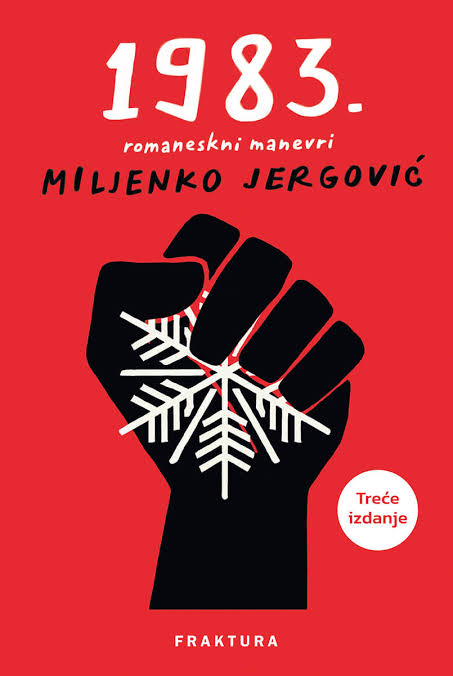
1983. 1983: Novelistic Maneuvers”, Miljenko Jergović, Fraktura
The quotation with which this text begins comes from the final chapter, entitled “Snow.” The flakes falling on the city are those mythical flakes of Sarajevo snow that came at the very last moment, during the night and the first day of the Winter Olympic Games in Sarajevo in 1984. On that day, with that snow, with that Winter Olympiad, the year 1983 comes to an end. An era ends – as much the era of great history as that of Jergović’s personal history. And it passes into a story never told before. Into a great and important novel of the kind that has not been written in these parts, and I cannot recall having encountered anything like it in other literatures either.
By a strange coincidence, the novel is about the year 1983, the year of Orwell’s terrible 1984 – a year that in fact arrived much earlier and arrives much later, now. Historical and personal circumstances happened to coincide, but that coincidence is not accidental: 1983 says a great deal about Orwell’s 1984, not in any vulgar or straightforward way, but rather as a shadow hanging over it. Nor is it accidental that the year 1983 ends some forty days later, in 1984.
Time and history have a habit of beginning earlier and ending earlier, or the other way round – the mythical sixties of the last century continued deep into the calendar seventies; the twentieth century began with gunshots in Sarajevo, fourteen years after its calendrical beginning, and ended with the fall of the Berlin Wall (Jergović will say, and he will not be wrong, no, the twentieth century ended on that last day of 1983, which did not fall on December 31, 1983, but with the Sarajevo snow in February 1984). Calendars have been reliable, or at least agreed upon, for the last hundred-odd years. But history does not obey them. It nests itself in dates as it pleases. Thus the twentieth century begins fourteen years after its calendar opening, in 1914 in Sarajevo. Or perhaps twelve years before its calendar opening, in 1888 in London, when, as he himself claims in the graphic novel and later film “From Hell”, it was delivered by Jack the Ripper (that sentence, wholly fictional and a product of the author of the graphic novel, never appeared in the letters Jack the Ripper sent to newspapers and police, just as today one can say with near certainty that most or all of those letters were the product of diseased imagination and hoaxes, and that one may state with considerable confidence that none was written by the real killer – which does not diminish the possibility that Jack the Ripper really did deliver the twentieth century). After all, the Second World War ended on May 8, when in fact nothing really happened. The Germans signed capitulation with the Western Allies on May 7, but the Soviets wanted their own signature too, so the Germans signed again with them on May 9. What I mean is that history cannot really be forced into dates; it resists that, like an animal caught in a trap. And in that place, where it struggles to wrench itself free, great and important books of history arise, and even more so – literature.
That is why Jergović is right (just as much as he is wrong, but that is completely beside the point) when he says that the twentieth century ended in 1983, which itself in fact ended only in February 1984. He “argues” about it beautifully (fictionally, of course) with one of the greatest historians, Eric Hobsbawm, who claims that the twentieth century ended in 1989. The important reasons (and I would say rather accurate ones, at least from our present perspective) why the twentieth century ended in 1983 I will leave for you to discover on your own after you read 1983. The one reason that matters less to history but most to the author I will reveal, because the author himself reveals it in the opening lines: it is the last year of freedom, innocence, childhood, youth, untroubled longing – and the first year of great fear before what is coming, after which the world will no longer be the same: military service. That year, as anxiety mounts with the approach of the moment when he will board the train to carry him to one of the barracks, the author’s view of the world around him begins to change. He sees with the eyes, and the gaze, with which, forty years later, he will write the novel

Today it may sound foolish, but back then (and for most men born more than fifty-five years ago in this region) it was one of the turning points of life. A year, or a year and a half, in which life was split into before and after. Today, I suppose, there are other personal dates like that. I hope it stays that way, and that conscription, which is once again being loudly announced, does not become such a turning point again
In 1983, Miljenko Jergović is seventeen, looking at the world through the eyes of a seventeen-year-old boy who wants a girlfriend, wants a certain record that cannot be found in the shops, reads books, longs for a black leather jacket, and inexorably feels the ticking of the clock drawing him ever closer to the end of all that. At the same time, he tells this story now – I will not mention how old he is – while simultaneously seeing through the eyes of his seventeen-year-old self, remembering that seventeen-year-old self, and narrating from the perspective of the present, when he knows how everything turned out. This gives him the space to hold tightly to that watershed year, but also, in parallel, to move forward and backward as the story leads him, or as he leads the story. I believe, though I cannot know it for certain, that both things happen equally: at times the story leads him, and at times he leads the story. The narrative itself often makes a very long leap, drifting far from the point at which it began, veering into seemingly insignificant side channels, only to return. And then those channels become important in some other chapter. It is a weaving like memory and present reality happening at once. That ease of weaving and interlacing the story is astonishing. And what gets interwoven really is everything: personal experiences and intimate stories, urban legends and reality, major world events, major domestic events, seemingly unimportant everyday life, silenced and forgotten incidents, important and “great” figures and personalities, figures who were once important and are now forgotten. Or “unimportant” figures at the edge of “important” events. It is wondrous weaving and wondrous storytelling, which is at once factual investigation and emotional experience and intimate story and chronological recording of visible reality and of what is happening beneath the surface… What matters is that the reader, just like Jergović, will experience much of it personally, because he or she personally lived through it or something similar, but did not know how to turn it into words. Those who remember the events and things thundering in the foreground of “1983” or in the
background of the narration will feel and experience it just as strongly as those hearing or reading about them for the first time. There are many hooks here that connect our intimate histories and experiences with those Jergović is telling. That is why the subtitle itself says these are “novelistic maneuvers”: the author uses that phrase in one of the chapters, although “1983” is in fact a novel. Why then “novelistic maneuvers”? Because almost every chapter, or at least every odd one, could have become a novel in itself. I would even say it ought to have become one. And I am almost certain Jergović himself would love (and be able) to write all those novels. Recognizing the story, recognizing the novel where none seems to exist – that is Jergović’s astonishing talent, perhaps the greatest in this part of the world.
But the woman who loved Ranković, by the logic of drama, simply could not have been a criminal. She is a heroine of the choicest Balkan kind, the guardian of a bankrupt history and of failed ideals, but above all else the guarantor of the right to suffer of one who at a certain moment found himself on the defeated and despised side.
1983. 1983: Novelistic Maneuvers”, Miljenko Jergović, Fraktura
That quotation comes from a chapter about the death and funeral of Aleksandar Ranković (but also about much else). From those two sentences alone one can already sense a Greek tragedy or a great novel that ought to be written.
Or the story about the women who that year discover the charms of Istanbul’s bazaars (Istanbul in those years partly replaces Trieste as a shopping mecca and window onto the West, though of course it lies in the East).
The smell of leather jackets rises up, and the smell of synthetics too; the women catch that intoxicating scent of ready-made clothing, a scent they will all through the years of socialism easily and willingly mistake for the smell of the wider world. And strong, strong as faith in a believer, will be their conviction that there are no such jackets and no such blouses in our shops. The longing for what our shops do not have, this people will a few years later confuse with faith, with nationhood, and with the natural human longing for freedom.
1983. 1983: Novelistic Maneuvers”, Miljenko Jergović, Fraktura
There are many such “novels,” Greek tragedies, and the occasional comedy told in the chapters of “1983”. At the same time, Jergović covers almost all the important and pivotal, now almost forgotten events that we might call trivial, though in fact they were signs of new and significant trends, seemingly minor cultural shifts that would later acquire either great personal meaning or simply great meaning: traffic accidents, films, records, novels, poetry collections, court trials…
All those things that remained in one’s memory and outgrew it. But let there be no mistake: this is not merely memory. It is serious chronicle
work. The author does not rely on memory alone; he researches, he describes in detail, pulling forgotten names, dates, and years out of daily newspapers, dusty almanacs and encyclopedias, feuilletons and interviews.
Memory is, of course, a deceptive thing. But worse than that is good memory, because if you remember exactly how it was, while others remember it the way it merely seems to them to have been (and that is how most people remember), it is a curse that makes you an outcast.

And Jergović – I can attest to this personally – has an astonishing memory. For a writer, that is a gift from heaven. But also a curse. For it is hard to remember what others do not remember, or do not wish to remember, or worse still, remember wrongly. “1983” is about that too, and that is very important. Just as it is about forgetting
Memory and forgetting are curses of this region.
A strategy of forgetting is important both for the life of an entire community and for the life of every individual. Family and social harmony are to a great
extent founded on strategies of deliberate forgetting. One day, in the distant future, people will talk at length about a culture of remembrance. That phrase will remain largely unexplained, but everyone will use it all the same. A culture of remembrance will become an important social imperative. Yet just as there will be a culture of remembrance, so too there will be a culture of forgetting. One might also say this: for a culture of remembrance to become possible at all, it must be preceded by a developed, cultivated, and profoundly empathetic culture of forgetting. Whoever lacks the prerequisites for a culture of forgetting, and whoever does not want to forget, will also be unable to remember in a way that respects the other’s right to remember. And the culture of remembrance, in truth, always speaks only of the other’s right to remember1983. 1983: Novelistic Maneuvers”, Miljenko Jergović, Fraktura
The novel – I will allow myself the audacity to call “1983” a novel once again – was published as a
series of texts in “Express”. Once upon a time it was a good habit of weeklies, monthlies, and daily newspapers to publish great and important novels in installments (or, if they were shorter works, in a single issue). Hemingway’s “The Old Man and the Sea” came out in “Life” magazine, Bradbury’s “Fahrenheit 451” in “Playboy”, and earlier still “War and Peace” and “Anna Karenina” by Tolstoy, and almost simultaneously “Crime and Punishment” and “The Idiot” by Dostoevsky, were all published in the journal “The Russian Messenger” (admittedly a literary journal, but in tsarist Russia, as in other authoritarian regimes, such journals also played the role of today’s political news magazines). The owner and editor of “The Russian Messenger”, Mikhail Katkov, had secured for himself a world exclusive; he was also owner and editor of the daily “Moscow News”. Dumas, Dickens, Conan Doyle, Flaubert… all of them appeared in weeklies, magazines, and daily newspapers. That good old habit slowly and, I would say, needlessly died away, only to be partly revived in a different form in digital media. Jergović and “Express” have revived that good old habit, and I am glad of it. If for no other reason, then because some customs ought not to be trampled by time. Some forms of forgetting are simply not good.

But that is not the reason why “1983: Novelistic Maneuvers” is a great book – because it is that, a great novel. I do not recall anyone in this region (nor can I think of global examples) having written such a novel about a single year. We do not know where the rest of critics will place it within literature, but that is not important. At least not at this moment. But I am certain that readers will find themselves in it, and their memories and forgettings objectified in words they themselves would not have been able to utter. And that is surely the mark of a great novel.