Beneath the silence, something lurks
'The Bird Tribunal' is a novel about two outcasts who, through a series of unfortunate circumstances, find themselves in an isolated place
Ever since I started writing fiction, and allowed myself to be called a writer, my relationship to reading has changed significantly. Now that I have less time for it, I choose books carefully, informing myself in advance about the plot, the characters, and the writer’s biography, so that I can make the best possible selection of literature I will enjoy and that will move me in some way. Books are “easier” to read this way because we know the context of time and place, but at the same time the element of the unexpected that comes with twists is taken away, because with some books you have to avoid spoilers, especially when it comes to crime novels, where the plot twist is crucial. This rule does not apply to literature that belongs to the peaks of world literature, because we enjoy it time and again without caring that we know how, for example, Anna Karenina, Emma Bovary, or Thérèse Raquin will end. Still, when I read “for business,” I inform myself about books only after I have read them, because I want my impressions to depend exclusively on the text, and not on my assumptions and expectations.
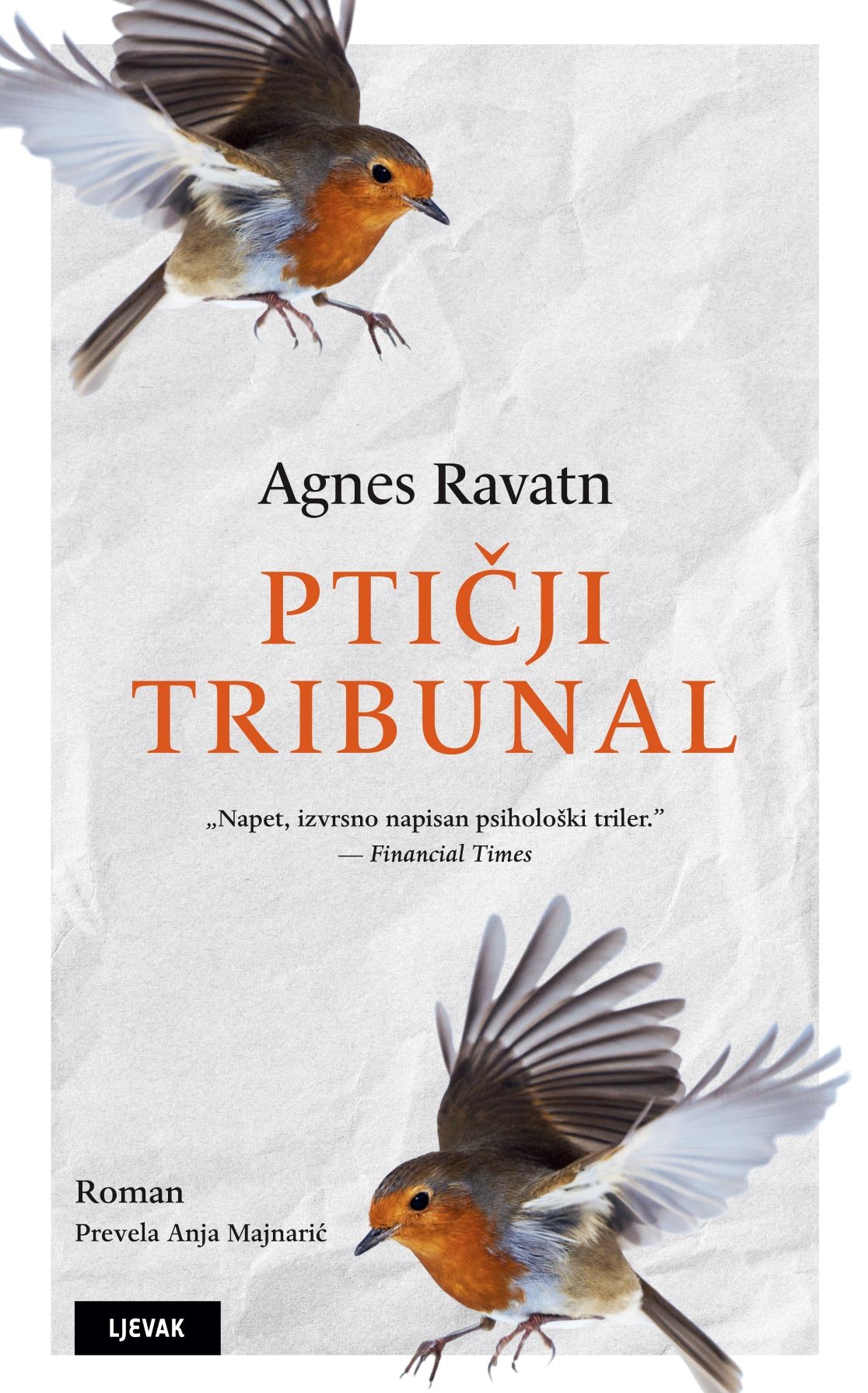
At the center of the novel “The Bird Tribunal” by the Norwegian writer, essayist, and columnist Agnes Ravatn are two characters, two loners and outcasts who, through a chain of very unfortunate circumstances,
end up together in a small, intimate isolated space. Namely, Allis Hagtorn, after leaving her husband and her job in the capital because of a public sexual scandal, finds work as a housekeeper and domestic servant with the rather secretive and rigid Sigurd Bagge, who makes it clear to her in advance that there will be no interaction between them except formal interaction during the serving of meals. Still, as time passes, their relationship slowly changes. At night, from time to time, they would stay up late talking, creating an illusion of connection that would completely vanish by morning. The story is narrated by Allis, whose narration moves from an entirely intimate “I” into wholly unknown territory, the darkness that surrounds Sigurd, distancing us from him even more, and from the very beginning we are certain that the key to the novel is in his hands
Ravatn is very skillful; her language and style are clean and minimal, she builds the plot gradually and flawlessly in very short chapters, and the setting, the landscape near the magnificent, proud, cruel Norwegian fjords, contributes greatly to the atmosphere of isolation and loneliness, making it perfect for some kind of Nordic noir. “The Bird Tribunal” is not that, and I would by no means call it a crime novel, although it contains some elements of that genre. If we absolutely have to define it in that sense, it could be called a psychological thriller, although I must admit that I did not experience it that way until the final third of the novel. Until then I was reading a drama, and wondering where Ravatn would take us, how she would resolve the possible love relationship and Sigurd’s mystery.
The tension, which truly does exist in the text, is hidden beneath the surface, and here and there one feels even a pinch of unease, which lies in the details and in careful reading. It is such subtlety that the translator, Ana Majnarić, instead of an afterword, wrote an essay titled “Is There Horror in ‘The Bird Tribunal’?”, in which she set out how many uncertainties there actually are regarding the genre classification of this novel, because besides containing elements of crime fiction and the psychological thriller, on the basis of its synopsis it could also function as a love story. A film is also being made, after the successful theater play, and film as a medium can be more suggestive than literature, so I assume that the feeling of unease might be more obvious there
Sigurd Bagge is one of those characters who are omnipresent in the Victorian novel: tall, dark-haired, distant, dark, and mysterious; for comparison, Heathcliff from “Wuthering Heights” would serve well. I would not say this should be taken as a weakness of the novel, that the author has portrayed the male character stereotypically; on the contrary, she deliberately uses elements of different genres and creates a new story that works flawlessly, and that is the only thing that matters for the text. Ravatn does not repeat herself, does not explain, but rather counts on a devoted reader, and that should be appreciated. Besides that, the novel heavily refers to Norse mythology: birds, as a link between heaven and earth, the worldly and the spiritual, move away from the usual symbols and assume a much darker role – that of the final judgment.