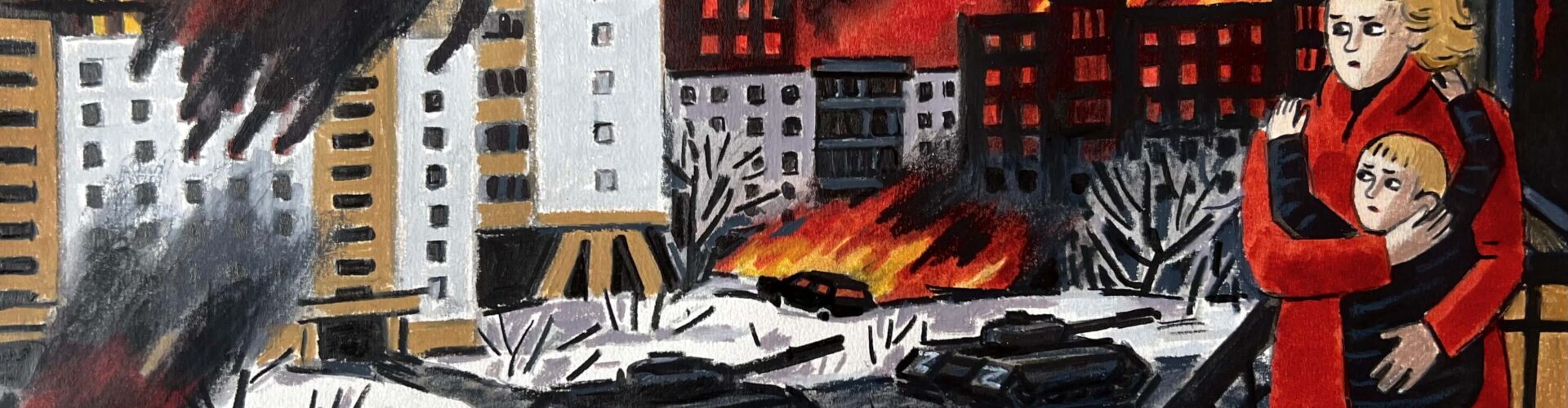
This is not a dystopia, it’s reality unfolding!
Paul Lynch’s 'Prophet Song' shows how ordinary life can descend into totalitarian horror almost without anyone noticing
…but tradition is nothing more than what everyone can agree on – the scientists, the teachers, the institutions, if you change ownership of the institutions then you can change ownership of the facts, you can alter the structure of belief, what is agreed upon, that is what they are doing
Prophet Song, Paul Lynch, Oneworld Pulications, Dublin, 2023
One day two policemen knock on Eilish’s door. They are looking for her husband, one of the leaders of the teachers’ union. Nothing important, nothing urgent. They just have a few questions. He should report to them when he gets home. That is roughly how the novel “Prophet Song” begins, in which ominous little questions, ominous little legal changes because of a state of emergency (it is not known what caused the state of emergency or whether such a cause even exists), the ominous little founding of a new police department, the ominous little arrival of one party in power, turn into the end of the world. Their world, some world whose disappearance is merely a string of news items on television…
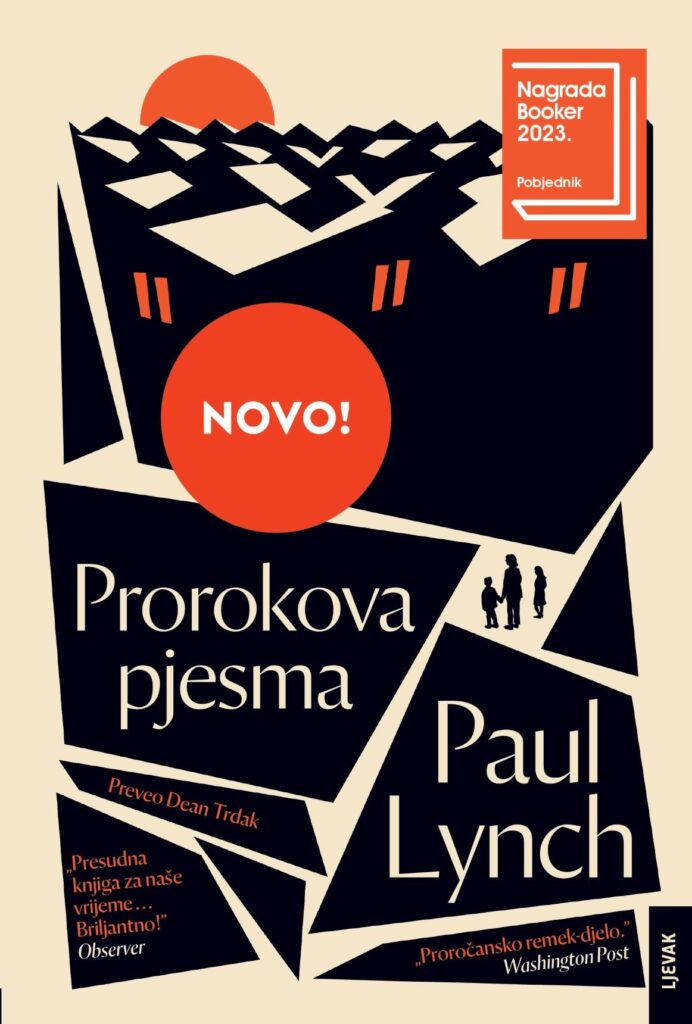
Paul Lynch tells a terrifying story that at times reminds the reader of Kafka’s “The Trial”, at times the rise of fascists in the 1920s and Nazis in the 1930s, and at times Orwell’s “1984”. Stories we know so well, yet, sunk as we are in a world of democracy and human rights, we have rather thoroughly, not to say completely, forgotten. But
that is not what is terrifying. What is terrifying is that “Prophet Song” looks like the news we follow in newspapers. Today. Right now. It seems that almost nothing in the story is exaggerated. The disappearance of the father, the husband, who after a second interview may have been arrested, or perhaps not. No one answers. The slow abolition of one right after another, the slow disintegration of the family, which Eilish feverishly tries to preserve. The disappearance of the neighborhood, of society, of understanding…
In all of this, the reader, just like Eilish, feels like a helpless mouse trapped in a maze. And let us remember, it all began with only small changes in legislation, small emergency measures, small, seemingly unimportant alterations in institutions, only to grow like cancer into the complete disappearance of any connective tissue between the individual and society and the state. Perhaps that is precisely what is most frightening in the novel: all those seemingly unconquerable fortresses of Western democracy, Western society, indeed civilization itself, melt away, as the Železničar (The Railwayman) in the cult series “Where the Wild Boars Go” (“Kuda idu divlje svinje”) would say, “like shit in the rain.”
But what you are talking about is only an opinion. It is not any opinion, it is a fact before the law. A fact. Yes, there is the rule of law, you cannot violate our rights like this. The rule of law. That is what I said. You speak of that word as if you understand what the word rights means; show me which rights are inherent to man, show me the stone into which they are carved, where nature determined it so.
Prophet Song, Paul Lynch, Oneworld Pulications, Dublin, 2023
What is terrifying is that, while reading “Prophet Song”, we can really understand, and even justify, how easily all those inalienable rights disappear, all those traditions, all those institutions that protect us. In this case, the right that seems inalienable in today’s civilization (although it is precisely that right that has most often been violated, distorted, by emergency situations, the homeland, and who knows what else), the right that has been abolished, is habeas corpus. It seems pointless, doesn’t it? I won’t go now into legal explanations of habeas corpus, nor into a sophisticated discussion of what it means, but roughly it would mean that the police (or whatever body of order it may be) must bring you before a court (or some other independent body) which justifies or refutes the legality of the arrest.
It sounds pointless, nothing special. But in “Prophet Song” (and, I would say, in reality as well), that is where everything begins. If the police, the secret police, or any state service can make arrests without having to justify the arrest to anyone; that means… Well, try to imagine it. In fact, you do not need to imagine too much. All of that has already happened in reality, or is happening right now. After that seemingly small and not very important change due to the state of emergency, what is again terrifying is that we do not know what this state of emergency is, which again means that anything and nothing may be the reason for a state of emergency, which, moreover, most people do not even understand, and then all the other rights, all the traditions, everything considered sacred and inalienable, begins to collapse like domino tiles.
Although the novel could be called dystopian, and it certainly contains elements of dystopia, it is not that. It would be more accurate to call it hyperrealistic. Because although things have not gone quite that far, it seems that parts of what happens in the novel are all around us. I repeat, what is terrifying is how one seemingly tiny change can destroy everything we considered inalienable and sacred. That is precisely how Paul Lynch tells Eilish’s story, as if it were happening now, as the background to some news item we have read in the papers (ah yes, newspapers are also one of those institutions whose meaning for our lives we will discover one day when they are no longer there, and believe me, I hope that happens sometime far, far in the future). He slowly immerses us, together with Eilish, in deeper and deeper circles of horror that peel away somehow by themselves.
That helplessness is terrifying too, and the reader will certainly feel it while reading, when from one normal life one enters a nightmare in which, without knowing why, suddenly you cannot get a passport, your seventeen-year-old child receives a military draft notice (hmm, suddenly conscription is introduced; doesn’t that remind you of any other country?), members of the ruling party suddenly advance at work (hmm, does that remind you of any country?), then the unsuitable ones lose their jobs (hmm, that too might remind you of a country), are publicly denounced as traitors… Hmm, does that remind you of anything?
What Lynch does, by placing us in Eilish’s skin, is make us feel powerless like her, but equally undecided about how to react… Should one try to keep the family together, wait to find out what happened to the husband and father, wait for the madness to stop: do these things make everything worse, harder to tear oneself away from, flee, and save what can be saved? Eilish has no answer to that; she is carried along by the river of events, just as, I believe, most readers would be. What makes the whole thing even more real and frightening is the way Lynch tells the story: through constant retelling of dialogues, events, dreams, reactions, he further intensifies the sense of helplessness to break away from the story, to stop being the object of narration and become the subject. On the one hand, that way of narrating slows the story down, further emphasizing the gradual sinking into an abyss with no way out, but on the other hand it drives the reader to turn page after page, almost painfully, in search of an exit, a catharsis, some ending that is not exactly happy, but at least less unhappy. Which perhaps still will not come.
She looks toward the sky watching the rain pass through space, and in the ruined yard there is nothing else to be seen except the world persisting in its own existence, the slow decay of concrete that spills over into mud rising from below, and when the yard is gone there will remain only the persistence of the world, a world that stubbornly insists it is not a dream, and yet the one who watches it cannot escape that dream nor the cost of life, and that is suffering, and she sees her children brought into the world of loyalty and love and sees them cursed in a world of horror, and she wishes such a world would end, that it would be destroyed, and then she looks at her infant, this still innocent child, and realizes that she has betrayed herself, and she is horrified, because she sees
that from horror comes compassion, from compassion love, and from love the possibility that the world may once again be redeemed, and she sees that the world does not end, that the thought that the world will end in your lifetime by some sudden event is mere vanity because what is ending is life, and only your life, because what the prophets sing of is one and the same song sung through time, the coming of the sword, the world swallowed by fire, the sun that at noon sinks into the earth and casts everything into darkness, the rage of some god embodied in the prophet’s mouth, anger because of iniquities that will be uprooted, and the prophet does not sing of the end of the world, but of what has happened, what will happen, and what is happening now, to some, but not to all, because the world is always ending again and again, but only somewhere, not everywhere, the end of the world is always local, it comes to your country, visits your city, knocks on the door of your house, for others it is merely a distant warning, a short item in the news, an echo of events that have already become folk legend…Prophet Song, Paul Lynch, Oneworld Pulications, Dublin, 2023