They left home, never to return
In Norwegian author Helga Flatland’s 'Stay If You Can, Leave If You Must.', youth, family and tragedy collide
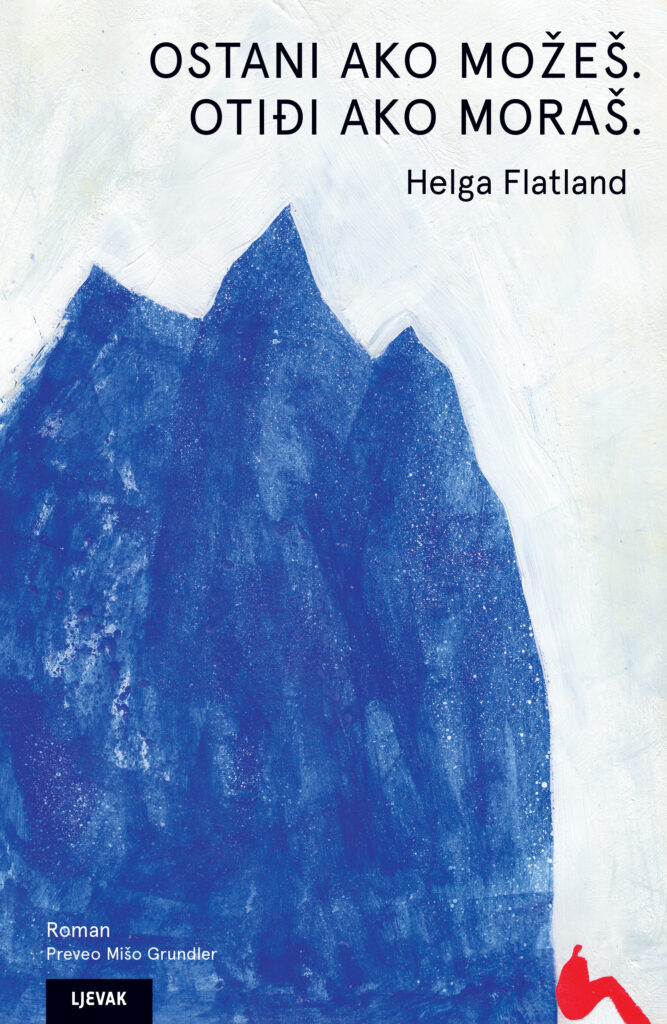
On the cover of “Stay If You Can. Leave If You Must.”, a novel by the Norwegian writer Helga Flatland, you are confronted at once with a major spoiler: Tarjei, Trygve, and Kristian, three young men from a small village, go to Afghanistan and are killed. Their deaths do not occur in the very first sentence of the novel, so the absence of that spoiler would surely have deepened the reader’s pleasure, or at least made for a more immediate and honest encounter with the text. But their deaths soon become an established fact (even though, as in real life, we go on hoping until the very last page that some mistake has been made, that someone else has died or no one at all – not our boys), and Helga Flatland’s novel turns afterword, not a book about the “politics of war”, but about the “politics of home.”

Taken as a whole, this story of life in a Norwegian village, a life whose central tension can almost be reduced to the words of the title itself, consists of four separate narratives, together forming the unwritten history of the village, all converging on the point of the three boys’ deaths. Only two of the three dead boys are also narrators: Tarjei, who opens the book, and Trygve, who closes it. Alongside them are the narratives of Jon Olav, Tarjei’s neighbor, and Karin, Tarjei’s mother. Yet these are not merely different perspectives on the same event. Tarjei’s story, about a boy who suppresses his own identity in order to conform to his parents’ expectations, is deepened by Karin’s story, set in the past, about a woman in a rural environment suffering from postpartum depression and therefore unable to
form a bond with her son. Jon Olav, meanwhile, takes us into another branch of village life, and into the future. His family begins to come apart when his son Sigurd gives himself over to what seems, at first glance, an excessive grief after the deaths of the three boys. They were not even his peers, and at first both the reader and Sigurd’s father, Jon Olav, are baffled. In the spirit of true hermeneutics, “Stay If You Can. Leave If You Must.” could almost be read circularly: by the end of Jon Olav’s section, we begin to understand the source of Sigurd’s “excessive” grief, but only after reading the final section, Trygve’s, can we return with full understanding to Sigurd, the young man who suffers because he had been secretly involved with Trygve.
The pieces slowly fall into place as the book goes on, but this is not a mystery novel in which each narrator contributes one missing part of the puzzle. Each voice is fully valid and complete in itself, almost like a novella. Grundler notes that Karin’s voice is “probably the most painful,” but although hers is the only female voice in the book, her section, paradoxically, left a somewhat weaker impression on me. The story I was most reluctant to leave behind, and the one that most powerfully embodies the tension contained in the title, is the first one, Tarjei’s. Tarjei wants to apply to art school, but at the last moment he crosses that wish out and puts down the local agricultural school as his first choice.
That, after all, is what his father expects of him. But his father’s “expectations” are not quite what one might assume. Lately there has been much talk about “fawning” as a trauma response: instead of fighting, fleeing, or freezing, one adapts, appeases, ingratiates oneself. That is exactly what Tarjei does. He is always doing what he thinks his parents want – before they even say it, even when they have never said it at all. His parents are supportive, both of him and of his sister, but in a way that creates an awkward emotional interdependence within the family, where any deviation is punished by a withdrawal of love. Tarjei lives under the weight of a vague but powerful guilt that restrains him before anything even happens. When his father sends him to tighten the lug nuts on the winter tires, Tarjei tightens them “so hard my knuckles turn white (…). If the wheels aren’t fixed tightly enough, Mum or Dad will die.” You may think this is simply ordinary concern for one’s parents, but that is only because you have not yet read the book. Tarjei saves all the money he earns from summer work, not so he can buy a motorbike or a guitar, but “so that I can always say: ‘It’s already done,’ whenever Dad asks me to do something.” His sister sums up his predicament best when she says she “can’t help him” by speaking to their parents on his behalf, because he himself “doesn’t do anything.” Tarjei is not outwardly forced into submission; rather, subtle emotional mechanisms
compel him to make other people’s wishes appear as his own. He dies without his parents ever knowing that he wanted to go to art school. And it is precisely because of all this that he ends up in Afghanistan. Only far away, very far away from his family can he escape the character he has grown into. And the army is the place where that character is rewarded: there, someone else makes all the decisions for you, and the highest virtue is the complete surrender of individuality and private desire.
A novel built on the premise that young people have to leave the village in order to become themselves could easily have lapsed into cliché. We have read too many stories, especially in today’s popular autofiction, about sensitive boys who wanted to be writers but were pushed into sports or family expectations. Helga Flatland’s novel, first published in 2010, is distinguished by its nuance and psychological depth. What it shows is a constellation of relationships that may appear less dramatic on the surface, but is in truth much more insidious. “Stay If You Can. Leave If You Must.” is a book in which no one is demonized, no one is assigned clear guilt, and yet it still ends in death.
It is a cliché to say so, but the true central figure here is the village itself: a closed community in which care and concern, however well-intentioned, gradually harden into emotional coercion. Warm and deeply moving, almost heartbreaking, really, written with extraordinary understanding for the themes it explores, “Stay If You Can. Leave If You Must.” captivates through its individual narratives, whose variety offers points of identification even to readers who did not grow up in a village, while also showing that the “size” of a community sometimes has less to do with geography than with a state of mind, with society itself.